





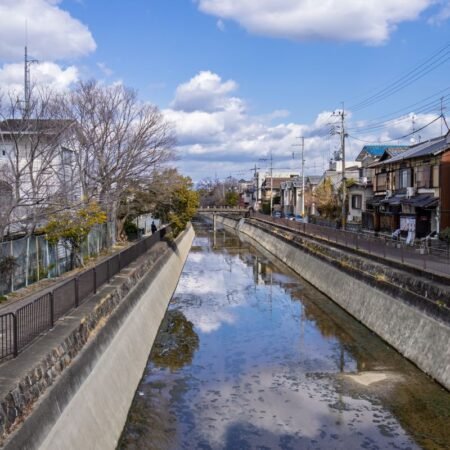
The queue outside Zenshoan doesn’t look like the queue for anything supernatural. It’s a dozen people standing on an ordinary Yanaka side street in the kind of August heat that makes your shirt stick to your back, waiting to file through the gate of a small Rinzai Zen temple one visitor at a time. There’s no fog machine, no actor in a white kimono. Just an elderly volunteer taking three hundred yen at a folding table and a hand-written sign in the temple’s front hall. Then you step inside, your eyes adjust to the dim tatami room, and about fifty silk scrolls are looking back at you.
I’d read about Zenshoan’s ghost paintings for years before I finally queued up myself, and what struck me wasn’t fear. It was how deliberately unspectacular the whole thing is. This is a working Buddhist temple that happens to own one of Japan’s most significant collections of Edo and Meiji-period yūrei-ga — ghost paintings — and once a year, for one month, it opens a side room and lets the public in to look at them. According to local and temple accounts, that’s been the arrangement for well over a century.
A Temple Built to Console the Dead
Zenshoan sits a short walk from Sendagi Station, in a pocket of Tokyo that has resisted redevelopment better than almost anywhere else in the city. The temple’s own history traces back to 1883, when the swordsman, statesman and Zen practitioner Yamaoka Tesshu is said to have founded it. Tesshu is one of the more remarkable figures of the Meiji Restoration — a retainer who helped broker the peaceful handover of Edo Castle to imperial forces in 1868, sparing the city a siege. According to temple accounts, he conceived of Zenshoan a few years later specifically to pray for the souls of those who had died during the upheaval of the Restoration, inviting a Zen teacher from Kokutai-ji in Toyama to formally establish it.
It’s a detail I keep coming back to: a temple founded, at its root, as an act of memorial for the dead of a specific historical moment. That context matters for what came later, because Zenshoan’s ghosts were never meant as entertainment for entertainment’s sake. They arrived by a much more personal route.
The Storyteller Who Collected His Own Fears
That route runs through Sanyutei Encho, widely regarded as the greatest rakugo performer of the Meiji era. Rakugo is a seated, one-performer storytelling art — no props beyond a fan and a hand towel, no set changes, just a voice building an entire world scene by scene. Encho was renowned above all for his ghost stories, including his own version of the “Peony Lantern” tale, and according to temple and biographical accounts he studied Zen under Yamaoka Tesshu, who became something like his spiritual teacher.
The story goes that Encho, needing fresh material and visual inspiration for the ghost tales he told every summer, began collecting paintings of yūrei — hanging scrolls depicting the pale, wild-haired, often legless spirits that populate Japanese folklore. Over the years he is said to have assembled around a hundred of them. When he died in 1900, at sixty-one, he was buried at Zenshoan, the temple of his teacher, and roughly half of his collection came to rest there with him. The temple has displayed them publicly every August since, timed to Encho’s death anniversary on the eleventh of the month, alongside a memorial event that the temple, the Rakugo Association and fellow performers still hold in his name.
What’s Actually on the Walls
The paintings themselves are the real draw, and they’re a genuine survey of how Japanese artists visualized the dead. Several works in the collection are attributed to Maruyama Okyo, the eighteenth-century painter usually credited with originating the now-classic image of the yūrei: a woman in a white burial kimono, hair loose and disheveled, hands drooping at the wrist, and — this is the detail that supposedly started the whole visual convention — no visible legs, fading instead into mist. Whether or not Okyo painted the very first legless ghost, as the popular account holds, is genuinely disputed among art historians, and I’d rather flag that honestly than repeat it as settled fact. What isn’t disputed is how completely that image took over Japanese ghost art afterward, and Zenshoan’s collection lets you trace it — alongside later, stranger, more expressive works attributed to artists like Shibata Zeshin and Kawanabe Kyosai, right through to the twentieth-century ghost paintings of Ito Seiu that were added to complement the older core collection.
Standing in front of them, what got me wasn’t any single painting so much as the cumulative effect of fifty of them in one dim room in August heat, the paper doors open just enough for a breath of air. It’s less a haunted house than a very quiet, very old art exhibition that happens to be entirely about death — which, when you think about it, is close to the original point of telling ghost stories in a Japanese summer in the first place. The tradition of gathering to swap a hundred candlelit ghost stories, hyakumonogatari kaidankai, and the Obon custom of welcoming ancestral spirits back for a few days each August, both sit in the same season. Encho’s collection, and Zenshoan’s decision to keep showing it, feels like a direct descendant of both.
Visiting Respectfully
If you want to see the collection yourself, it’s only shown for a limited window each August, so it’s worth checking the current dates and hours before you go rather than assuming last year’s schedule holds. Remember that Zenshoan is a functioning temple with an active graveyard, not a themed attraction — Yamaoka Tesshu and Sanyutei Encho are both buried on the grounds, and other families’ graves are close by, so keep voices down and treat the space with the same quiet you’d bring to any cemetery. Photography of the paintings is typically restricted or forbidden, so don’t assume you can shoot for social media; ask first, and accept no as the answer. The room is small and the visit is brief by design, so go in with patience for the queue rather than expecting a sprawling museum experience. And it’s worth sitting with the fact that this isn’t really a “haunted spot” story at all — it’s a memorial, built by a man honoring his teacher, filled with paintings collected by a storyteller honoring his own trade, in a temple that was founded to honor the dead of a revolution. The ghosts here were always meant to be looked after, not just looked at.
Note: images accompanying this article are illustrative stock photos and do not necessarily show the specific site discussed.
コメント