





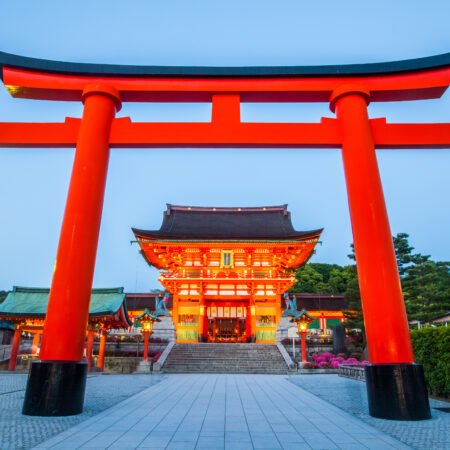

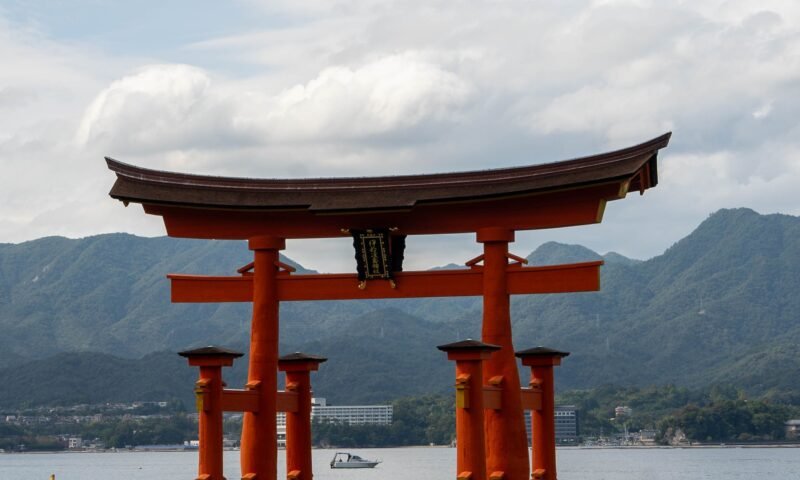
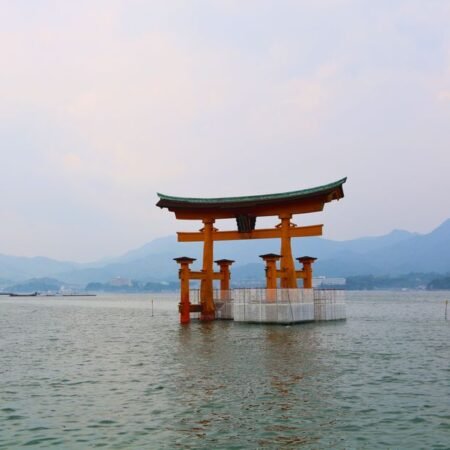
I took the last ferry of the evening from Miyajimaguchi, the way most people do, and spent the crossing doing what I always do on the way to a new story: reading the water. The tide was most of the way out, and the great vermilion torii that everyone comes to photograph was standing in wet sand rather than the sea, looking less like a floating gate and more like something that had simply been left behind by the water. It was only on the mainland side, waiting for the boat, that I noticed something odd: an unusual concentration of funeral halls and memorial-stone shops clustered around the ferry terminal, for an island with a population of only a couple of thousand people. It turns out that is not a coincidence at all. For well over a thousand years, Miyajima has operated under a rule that sounds more like the plot of a folk tale than a historical fact: nobody is supposed to be born there, and nobody is supposed to die there either.
A Shrine That Was Never Allowed to Touch the Ground
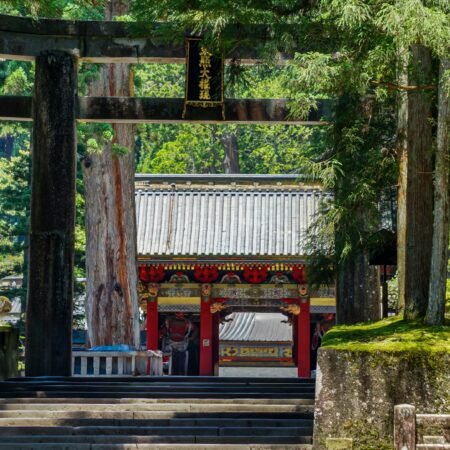
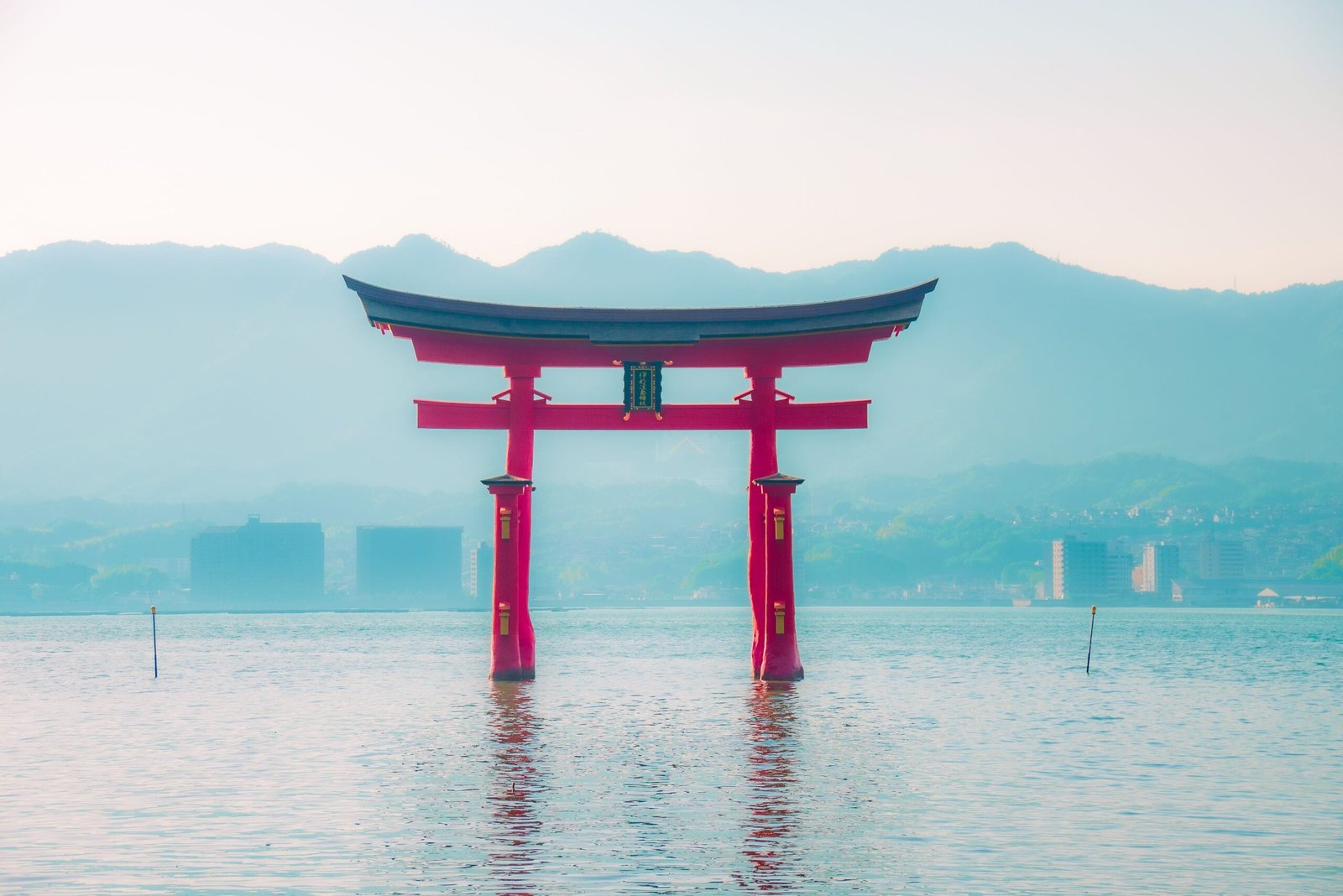
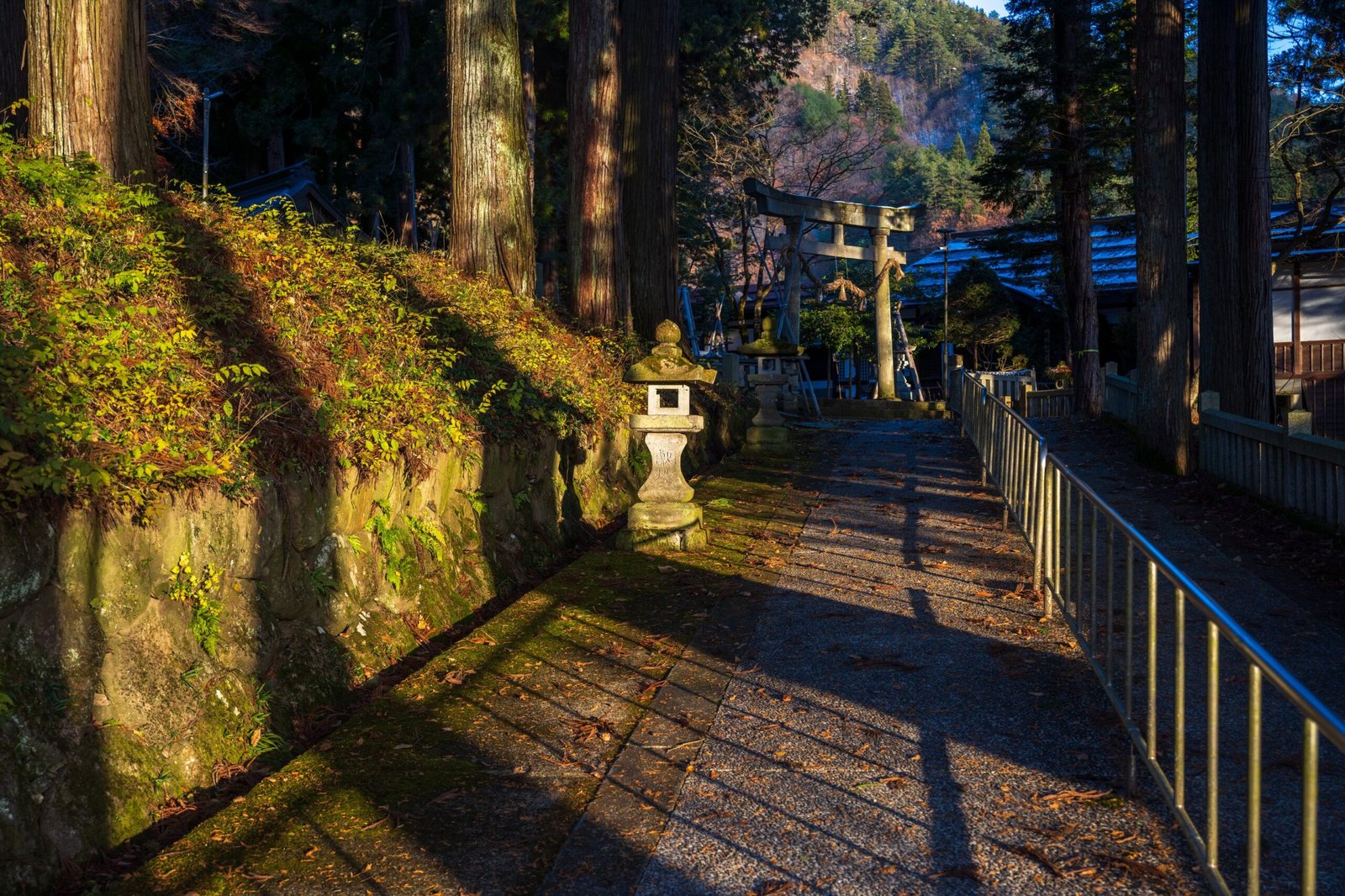
Itsukushima Shrine, the vermilion complex that gives the island its popular name, is said to have been established in 593, in the reign of Empress Suiko, after a local official named Saeki no Kuramoto received a divine instruction and, guided by a crow, sailed around the island with the resident goddesses before settling on the site. The shrine enshrines three sister deities of the sea, Ichikishimahime, Tagorihime and Tagitsuhime, and the island itself, Itsukushima, was considered so holy that the shrine’s halls were built out over the tidal flats on stilts rather than on the sacred earth of the island proper. Walking its corridors, you are, technically, never quite standing on Miyajima at all.
The shrine’s present form, the one appearing on every postcard rack in western Japan, is largely the work of Taira no Kiyomori, the warrior-courtier who worshipped there and rebuilt it in the aristocratic shinden-zukuri style in 1168. His patronage made the shrine fashionable with the imperial court, and emperors and shoguns kept visiting for the better part of a millennium afterward. None of that history explains the funeral parlours on the mainland side of the strait, though. For that, you have to look past the architecture and into the island’s oldest taboo.
The Island That Will Not Keep Its Dead
According to long-standing local tradition, the holiness of Itsukushima’s resident deities meant the island could not be defiled by kegare, the Shinto concept of ritual impurity most strongly associated with death and, less intuitively to outsiders, with childbirth. The practical result, as it is told today, was that a woman nearing her due date was traditionally ferried across to a birthing hut on the mainland and would not return for roughly a hundred days after the baby arrived. The dying, where possible, were moved off the island as well, and burial on Miyajima itself has long been treated as the greatest taboo of all. To this day, there is no cemetery anywhere on the island; islanders are laid to rest instead at Enmyoji, a mainland temple graveyard traditionally said to date from 1532.
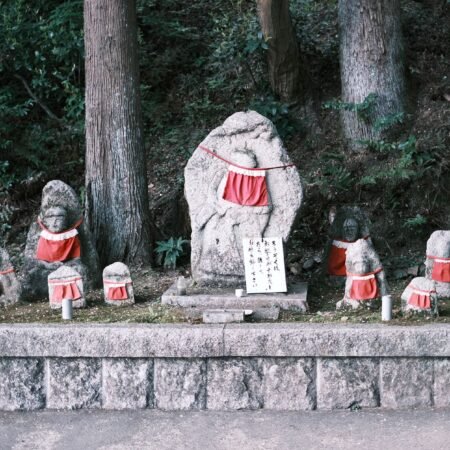
There is a small, easily missed monument to this crossing at Miyajimaguchi called Mukae Jizo, the “welcoming Jizo.” Boats once carrying a deceased islander to burial would circle the statue several times before putting in at the mainland, a parting ritual meant to see the dead safely on their way. The statue has since been relocated during redevelopment of the ferry terminal, and it is a far humbler thing than the great torii across the water, but local accounts say visitors still occasionally leave flowers there. Whether the old rule is still formally enforced is hard to say with certainty; islanders will tell you the stricter version of the taboo has loosened considerably since the Meiji era, and the more mundane truth is that Miyajima still has no maternity facilities of its own, so expectant mothers go to the mainland regardless of what anyone believes about kegare. Tradition and practicality, in this case, happen to point in the same direction.
Seven Mysteries on the Mountain of Spirits
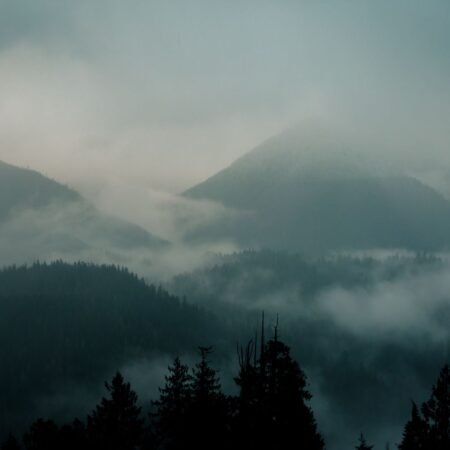
Behind the shrine rises Mount Misen, the forested peak that the whole island is really built around, and it comes with its own cluster of legends known locally as the Seven Wonders of Misen. The most striking, to me, is the Kiezu-no-Hi, the “flame that never goes out,” kept inside a hall at Daishoin temple near the summit. It is said to have been lit by the priest Kukai in the year 806 for a goma fire ritual, and local records describe it as having burned continuously ever since, tended in shifts by generations of monks, its embers divided and carried to new hearths whenever the old one needed renewing. One of those embers, according to a Miyajima tourism record, was carried off the mountain on the first of August 1964 to help light the Flame of Peace in Hiroshima’s Peace Memorial Park, where it still burns today as a quiet symbol of hope rather than grief.
Not every story on Misen is so gentle. Among the other six wonders is the sound of a wooden clapper, heard echoing from somewhere on the mountain with no one around to be striking it. Local tradition holds that whoever steps outside while the sound is in the air invites a tatari, a curse or misfortune, for their trouble, and the sound itself is blamed, without much more explanation than that, on a tengu, the mountain goblin of Japanese folklore. Nobody I spoke with claimed to have actually heard it, and I did not either on the evening I climbed to the summit for the sunset, but I will admit to walking a little more purposefully back down the ropeway path than I had climbed up it.
I do not think Miyajima wants to frighten anyone. If anything, the opposite: the taboo reads less like a ghost story than like an extraordinarily old piece of civic planning, a thousand-year-old way of keeping something considered sacred separate from the ordinary business of being born and dying, carried out with the same quiet, matter-of-fact seriousness the island still extends to its deer and its tide tables. That is, in the end, what keeps bringing me back to places like this. The legend is rarely the strangest part of the story; the part that actually happened usually is.
If you go, remember that this is a living shrine and a working island, not a theme park. Keep to the boardwalks and marked trails on Misen rather than cutting through the forest, particularly after dark, and give the sacred deer a respectful distance rather than feeding them by hand, since they can bite. Dress and behave as you would at any shrine when you pass through the torii, and be mindful that the quiet corners near Mukae Jizo and Enmyoji are still, for local families, places of real mourning rather than photo opportunities. Check the tide tables before you plan your torii photographs, since the famous “floating” view only exists for part of each day, and allow plenty of daylight for the mountain trails if you are climbing rather than taking the ropeway.
Note: images accompanying this article are illustrative stock photos and do not necessarily show the specific site discussed.
コメント