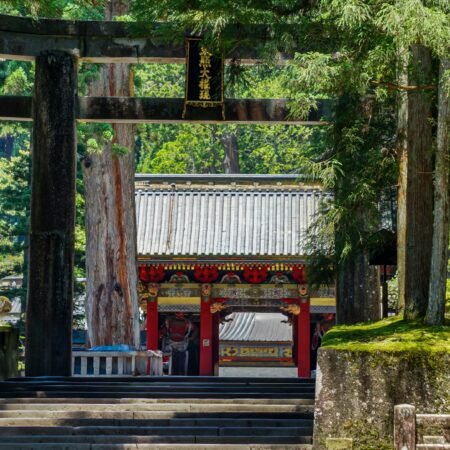






The first time I climbed Mount Takao, I wasn’t chasing a ghost story at all. I was chasing a day off — an hour on the Keio Line from Shinjuku, a mountain barely 600 metres high, the kind of outing Tokyo commuters do before lunch on a weekend. It was only when I reached the gate of Yakuoin Temple, about halfway up, that I noticed I was being watched by something with a very long nose.
Two carved figures stood guard on either side of the hall beyond the gate. One had a crow’s beak. The other had a nose that seemed to have given up on proportion entirely. Both were tengu — and I quickly learned that on this particular mountain, they aren’t considered the mischievous forest tricksters of folklore anthologies. They’re the mountain’s actual job description.
A Monk, an Emperor, and a Mountain of Training
Yakuoin’s own history places its founding in 744, established on the order of Emperor Shomu and attributed to the monk Gyoki, one of the most prolific temple-builders of Nara-period Japan. For centuries it functioned as a mountain training ground in the Shugendo tradition — the blend of Buddhist, Shinto, and folk-religious ascetic practice that treats mountains themselves as sites of spiritual testing.
According to the temple’s own account, the site fell into decline before being restored late in the fourteenth century by a priest named Shungen Daitoku, who had trained at Mount Daigo near Kyoto. The story goes that he performed a fire ritual to the deity Fudo Myo-o, burning eight thousand ritual sticks in succession, and that a vision came to him during the rite: the deity Izuna Daigongen, who he then enshrined as the temple’s principal object of worship. Whatever actually happened on that mountainside six centuries ago, it’s Izuna Daigongen — not Fudo Myo-o — who still presides over Yakuoin today, and it’s Izuna Daigongen’s household, so to speak, that gave Mount Takao its tengu.
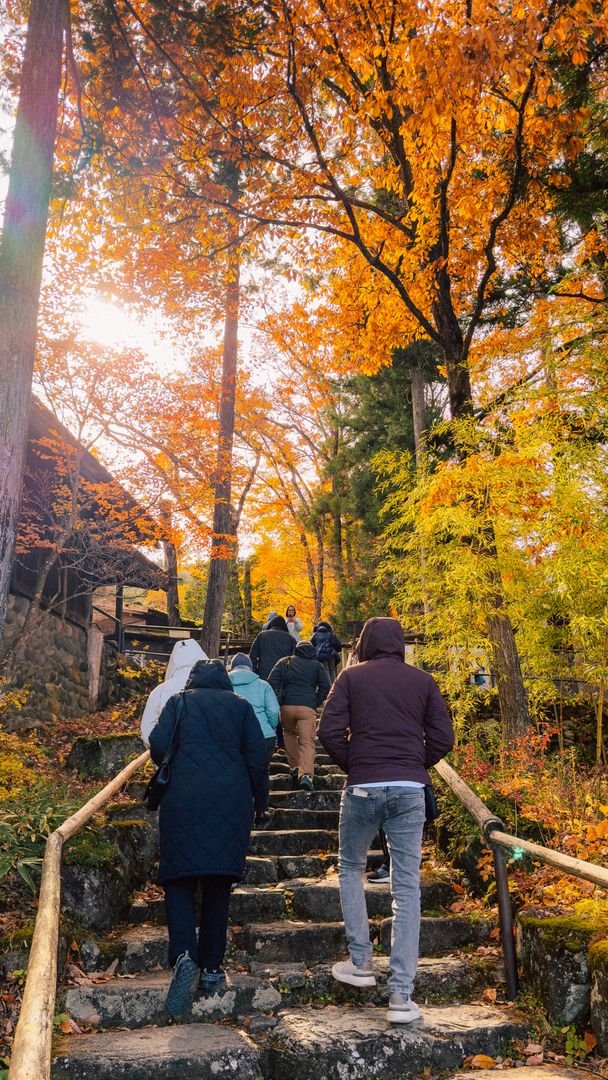
The God Who Wears a Tengu’s Face
Izuna Daigongen is an unusual figure even by the standards of Japan’s syncretic religious landscape. The temple describes the deity as a composite of five Buddhist figures — Fudo Myo-o, Karuraten, Dakiniten, Kangiten, and Benzaiten — fused into one. Scholarly reference sources on Shinto describe Izuna Gongen more simply as a kami whose cult originated at Mount Izuna in present-day Nagano Prefecture, usually depicted in a form resembling a tengu and riding a white fox, with Jizo as its Buddhist counterpart.
Accounts differ on exactly when this cult took shape — some trace it to the Heian period, while the oldest textual reference scholars point to is a thirteenth-century Kamakura-era document. I won’t pretend to settle that here; the local written record and the academic one simply don’t agree, and that kind of drift is normal for a cult of worship that moved between mountains and sects for the better part of a thousand years. What both sources agree on is that by the medieval period, a related practice had emerged called izuna tsukai — a form of folk magic involving fox spirit familiars, a detail that only reinforces how tangled this particular deity’s identity is with the imagery of sly, shapeshifting foxes as well as birdlike mountain spirits.
Two Warlords, One Tengu
What struck me most, poking through the temple’s records, wasn’t the theology. It was the client list.
Takeda Shingen and Uesugi Kenshin are two of the most storied rivals in Japanese military history, having fought each other to a bloody standstill across five separate battles at Kawanakajima in the sixteenth century. According to Yakuoin’s own history, both men were devotees of Izuna Daigongen. The Hojo clan, another major Sengoku-period power, is also recorded as having extended protection to the mountain. It’s a strange thought: men who spent their careers trying to destroy one another apparently found common ground in the same tengu-faced god on the same Tokyo-area mountain.
The temple’s fortunes continued under the Tokugawa shogunate during the Edo period, and Yakuoin now ranks as one of three head temples of the Shingon Chisan-ha sect, alongside the considerably more famous Narita-san Shinshoji and Kawasaki Daishi. Mount Takao’s tengu, in other words, have had some very well-connected admirers.
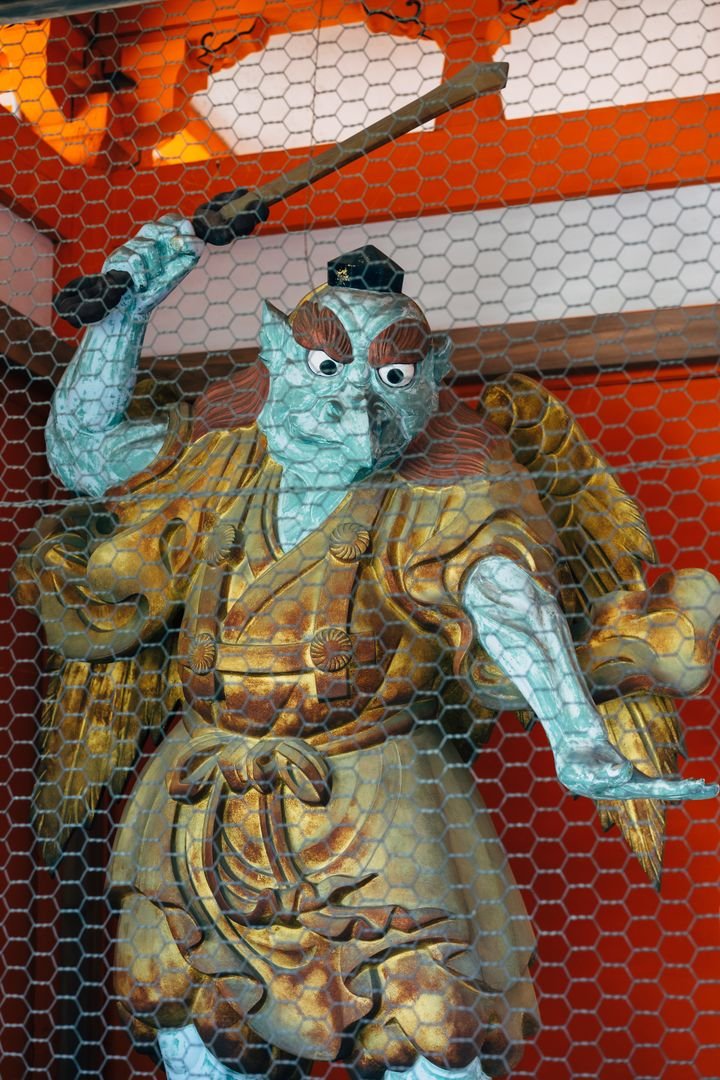
Not Demons, but Deputies
If you grew up on the version of tengu found in children’s books — red-faced goblins who steal misbehaving kids away into the forest — Yakuoin asks you to reconsider. Here, tengu are described as messengers of the gods and buddhas, tasked with chastising evildoers and protecting the virtuous, traditionally shown carrying a feathered fan.
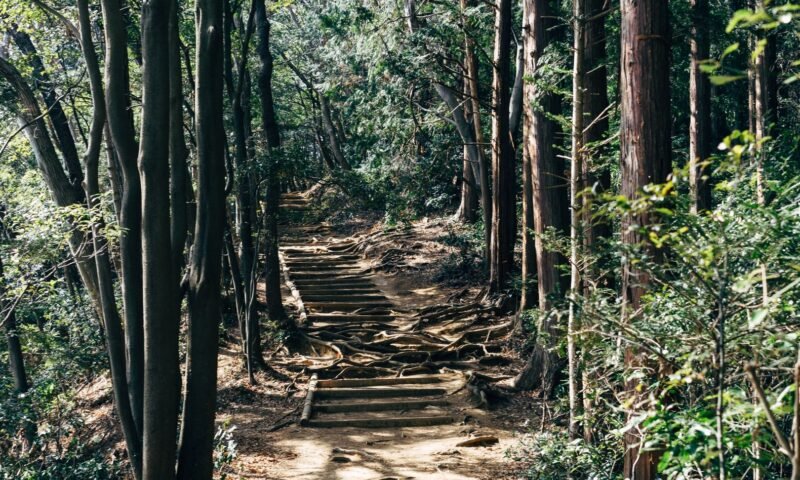
The two statues flanking the Izuna Gongen-do Hall make the hierarchy explicit: the smaller, crow-beaked tengu is said to represent one still undergoing religious training, while the larger, long-nosed figure is likened to an experienced yamabushi — a mountain ascetic who has completed the path. A further large tengu stands watch at the Shitenno-mon gate, the entrance most hikers pass through on Trail 1, the old pilgrimage route that leads from the gate up through Yakuoin and the Okunoin Fudo-do Hall to the 599-metre summit. In the context of Shugendo, the tengu isn’t an intruder in the natural world — it’s cast as the enforcer of the mountain’s own order, keeping watch over practitioners undergoing austerities and, by extension, over everyone else who comes up the trail.
That reframing is, I think, the actual story here. Mount Takao isn’t marketed or experienced by most visitors as a haunted place at all — it’s one of the most-climbed mountains in the world, reachable by cable car or chairlift from Kiyotaki Station, with eight marked trails of varying difficulty for anyone who’d rather walk the whole way. And yet the tengu iconography is everywhere once you start looking for it, a reminder that the mountain’s spiritual identity runs on a very different logic than the fear-based ghost stories elsewhere on this site. It isn’t about being haunted. It’s about being watched over by something that takes its job seriously.
Visiting Mount Takao requires nothing more than an ordinary day trip — the Keio Line runs directly to Takaosanguchi Station, about fifty minutes from central Tokyo — but a little courtesy goes a long way. Stay on the marked trails rather than cutting across the forest, and give way to worshippers if you arrive during one of the temple’s fire rituals or festivals. The tengu statues and the altars around them are objects of active devotion, not photo props, so resist the urge to touch them. Mountain weather on Takao can shift quickly even on a short climb, so bring a layer regardless of the forecast down in the city. None of this is a place that calls for a night visit or a flashlight — Yakuoin is busiest, and at its best, in ordinary daylight, surrounded by the kind of foot traffic that would make any self-respecting ghost give up and go home.
Note: images accompanying this article are illustrative stock photos and do not necessarily show the specific site discussed.
コメント