





I almost didn’t go. My neighbor Yoshida-san had mentioned something about a “big rope festival” in Naha a few days before, and I pictured, I don’t know, a slightly oversized tug-of-war at a company picnic. Twenty people, maybe a boombox playing enka in the background. I nearly stayed home with a bowl of soki soba instead.
I am so glad I didn’t. What I walked into on Route 58 that afternoon was not a company picnic. It was a 200-meter, 40-ton straw rope, thick enough that I couldn’t get my arms around it, surrounded by what felt like the entire population of Okinawa, all of them shouting at once. I have lived in Japan for five years now and been to a lot of festivals, but nothing quite prepared me for the sheer, bewildering scale of the Naha Great Tug-of-War.
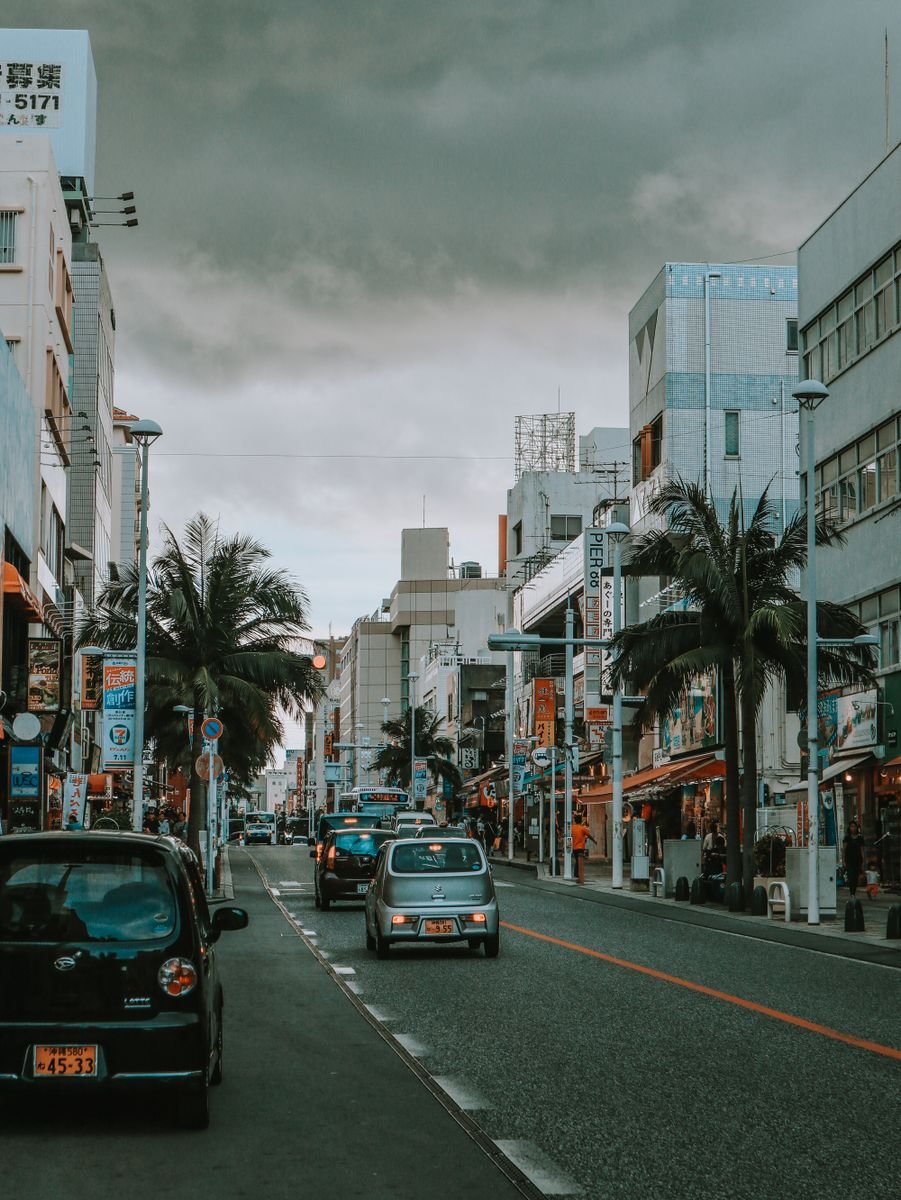
A Rope Bigger Than My Apartment
Here’s the thing that still doesn’t quite compute for me, even having stood next to it: this rope is rebuilt from scratch every single year, entirely out of rice straw, by hand. When it’s finished, it stretches about 200 meters end to end — split into a “female” half and a “male” half, each 100 meters — and at its thickest point it’s over a meter and a half around. The whole thing weighs more than 40 tons. From the main cable, 280 thinner hand-ropes branch off so that everyone in the crowd has something to actually grab onto, because there is no way several hundred people are getting a grip on something that wide.
This isn’t a new gimmick dreamed up for tourists, either. The tradition goes back more than 500 years, to village ceremonies praying for rain and a good harvest, which slowly turned into a rivalry between different neighborhoods of old Naha. Rules got formalized in 1812 after one too many disputes over fair play. The event was called off in 1935 and then obviously disrupted by the war, but it came back in 1971 as a way of marking the city’s recovery, and it’s been held pretty much every year since — 2026 is the 56th running. Guinness certified it as the world’s largest tug-of-war rope back in the mid-1990s, and locals will tell you that title with a quiet, totally justified pride.
Kings, Swords, and a 365-Kilogram Wooden Pin
Long before anyone pulls on anything, there’s a procession that honestly could be its own festival. Fourteen enormous hata-gashira — community flags on poles seven to ten meters tall — are carried down Kokusai-dori by representatives from neighborhoods across the city, each one meant to call down the protection of the local gods for their side. I watched this part first, squeezed in near Palette Kumoji with a can of orion beer sweating in my hand, and the flags alone were worth the trip.
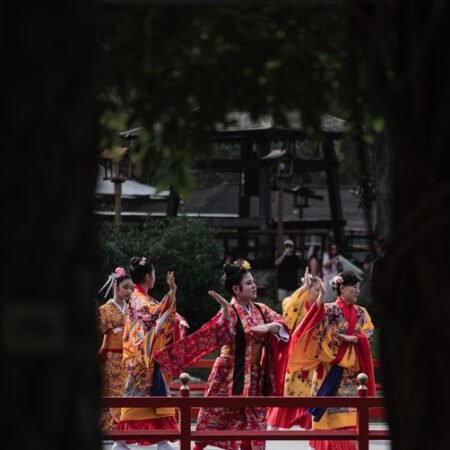
Then things get properly theatrical. The two halves of the rope — east and west — are hauled into position separately and have to be physically joined before the pull can even start. That job falls to a connecting pin called the kanuchi-bō, made of dark rosewood, 3.65 meters long and weighing 365 kilograms, one kilogram for every day of the year. Before it goes in, two men dressed as historical Ryukyuan kings are hoisted up on platforms and carried the length of the rope to face off with naginata in a ceremonial sword contest, while performers — martial artists, older women doing a slow fan dance, costumed figures locked in dramatic poses — act out little vignettes along the entire 200-meter stretch. It’s part solemn ritual, part full-blown street theater, and I couldn’t tell where one ended and the other began.
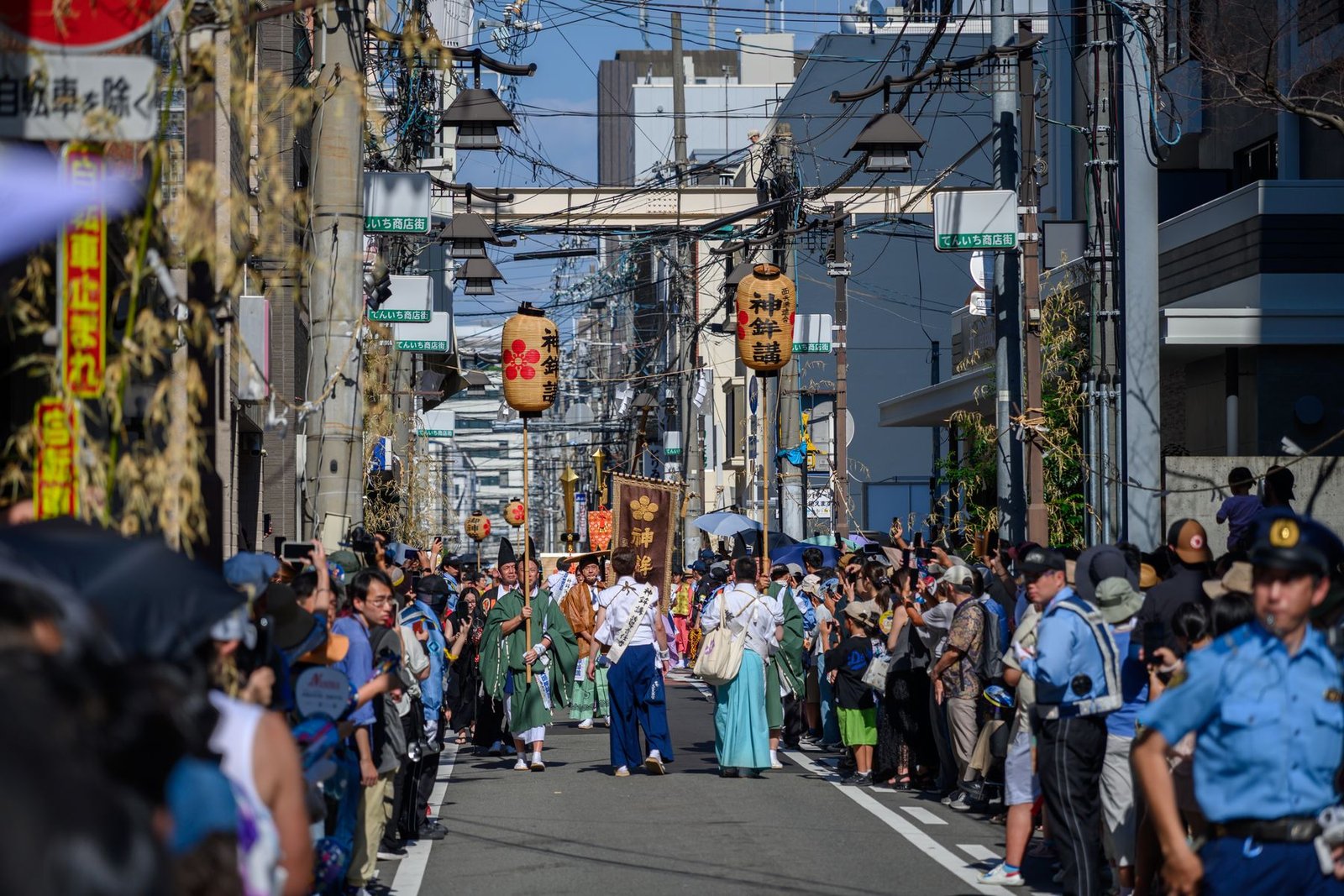
Grabbing On
Eventually the gongs sound, and that’s the signal. I’d told myself I’d just watch from the sidelines and take photos like a sensible adult, and then a woman next to me — maybe seventy years old, in a sun hat, utterly undeterred — grabbed my sleeve and pulled me toward the rope, and that was the end of my sensible plan.
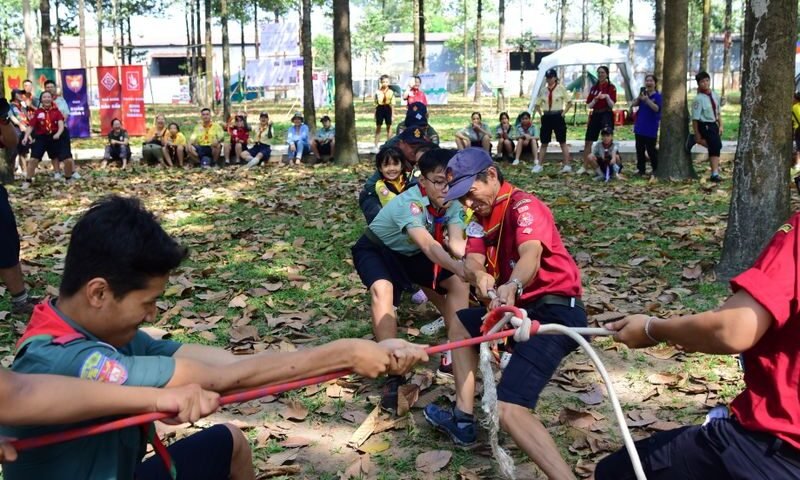
Up close, the hand-ropes are rough and a little damp with everyone’s sweat already, and the noise is unbelievable — drumming, whistles, someone screaming instructions in an Okinawan dialect I couldn’t follow at all. Around fifteen thousand people pull at once, with something like a quarter million more packed in to watch. Officially, the contest runs up to thirty minutes, and the side that drags the other five meters wins; if nobody manages that, whoever’s ahead when time runs out takes it. I genuinely have no idea which side I was on by the end, or who won. I just remember leaning back with both heels dug in, laughing, surrounded by strangers all doing the exact same thing.
When it was over, people swarmed the rope with pocket knives and little saws, cutting off pieces to take home — there’s a belief that a scrap of the hand-rope brings good luck. I got a short length of straw about the size of my hand, and it’s sitting on my shelf next to a stone from Yakushima and a bell from Koyasan, my small shrine to questionable souvenirs.
If You Want to Go
The 2026 festival runs October 10th through 12th, with the flag parade on Kokusai-dori the morning of Sunday the 11th and the tug-of-war itself at the Kumoji intersection on Route 58 that same afternoon, roughly 1:30 to 4:10 PM. The nearest monorail stop is Kenchō-mae, just a few minutes’ walk, and honestly, don’t even think about driving — there’s no parking near the venue and the roads close anyway. If you stick around into the evening, head over to Onoyama Park, a couple of stops away by monorail, for a citizens’ festival and fireworks around 8:30.
A few practical notes from someone who learned the hard way: it is still genuinely hot in Okinawa in October, so bring water and wear shoes you can stand in for hours, not sandals that’ll get crushed in the crowd. Skip the heels. Leave actual knives at home — there are rules about blades near the rope-cutting, understandably — and if you’ve got small kids, watch the crush near the pull itself, because it gets tight fast. Otherwise, just show up, find a gap in the crowd, and grab on. Nobody checks whether you’re a tourist, a resident, or someone who definitely did not plan on getting roped — sorry — into hauling a forty-ton rope on a Sunday afternoon.
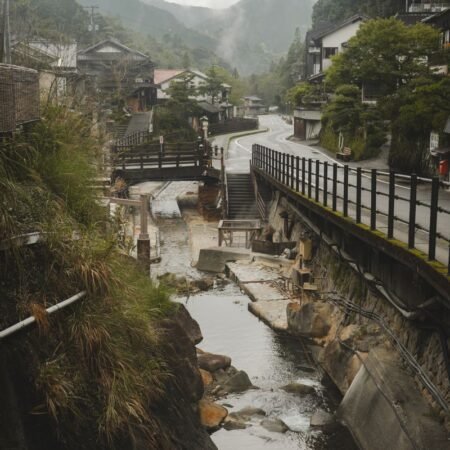
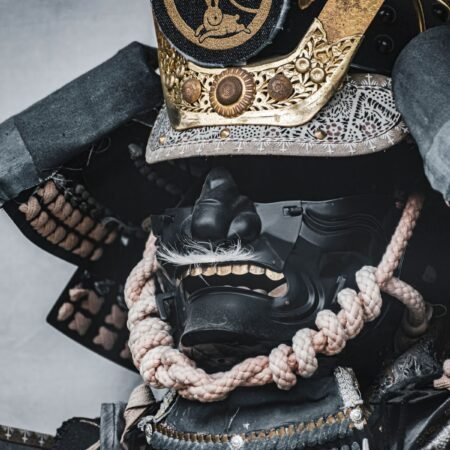
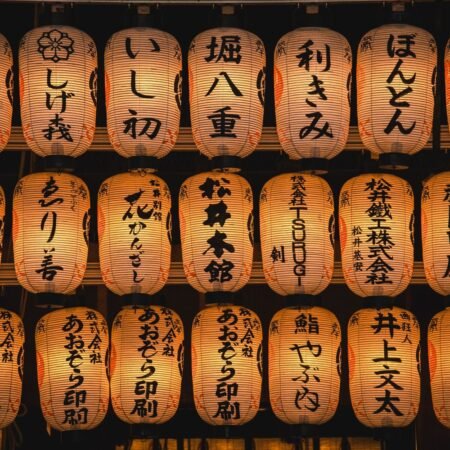
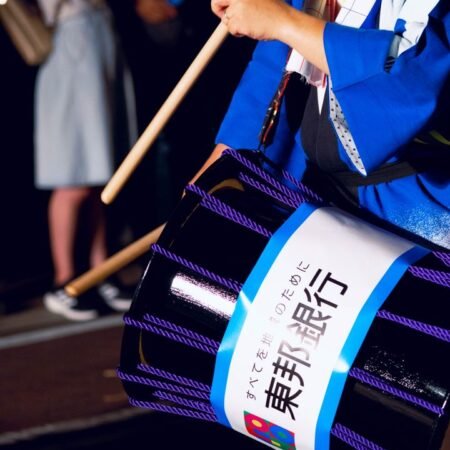
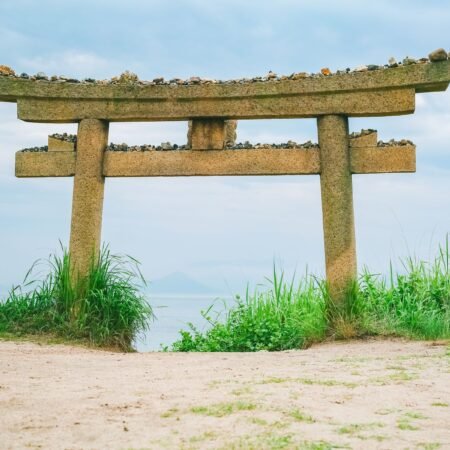
A quick note on photos: some of the images here are stock photos I’ve used to set the mood — they may not be the exact spot or moment I’m describing, just close in spirit.
コメント