






The boat cuts its engine about fifty metres offshore, and for a moment the only sound is water slapping against concrete. Gunkanjima rises out of the sea like something that was never meant to float this long — a grey silhouette of collapsing apartment blocks, stripped of glass and roofing, packed onto an island barely the size of a few football pitches. Our guide, a Nagasaki local who has been running these landing tours for over a decade, cuts the engine and says, almost as an aside, “Some of the crew won’t come out here after dark. Even in daylight, people say they don’t like to look up at the windows for too long.”
I had come to Hashima Island — better known by its nickname, Gunkanjima, or “Battleship Island” — because its silhouette had haunted me since I first saw a photograph of it years before I ever set foot in Japan. What I found once I actually landed there was less a ghost story and more a very human one, though the two, as usual in this line of work, turn out to be difficult to pull apart.
A City Built on Coal and Concrete
Hashima is a tiny island about nineteen kilometres from Nagasaki port, its entire six-hectare footprint reclaimed and built up around an undersea coal seam that Mitsubishi began mining commercially in 1887. Coal, not curiosity, is the reason the island exists in its current form at all. As the mine expanded, so did the settlement built to house its workers, and by 1916 the company had raised Japan’s first large reinforced-concrete apartment block on the island’s eastern edge, a structure locals still refer to simply as “Block 30.” More towers followed, stacked so close together that residents could apparently pass items between windows.
By 1959, at the island’s peak, roughly 5,300 people were living on that same six hectares — one of the highest population densities ever recorded anywhere on Earth. It had a school, a hospital, a cinema, a temple, a barbershop, even a small rooftop garden built from imported soil, all packed into a townscape that from a distance really does resemble a warship riding at anchor, which is how it earned its nickname. When I stood in what remains of the central square, it was hard to reconcile the wreck around me with the crowded, noisy, apparently quite lively community that older Nagasaki residents still remember fondly.
That history has a harder edge to it as well, and I don’t want to gloss over it. During the Second World War, some of the labourers sent to work the undersea pits on Hashima were Korean and Chinese conscripts, and the conditions they worked under were by most accounts severe. When the island’s mining complex was added to the UNESCO World Heritage list in 2015 as part of Japan’s Meiji industrial sites, that history became the subject of genuine and ongoing debate between Japan and its neighbours over how — and how fully — it should be acknowledged. I’m not going to pretend to settle that here; I’d rather point interested readers toward the historical record and the exhibition materials now displayed at the related information centre in Tokyo than reduce it to a spooky footnote.
The Stories the Boat Crews Tell
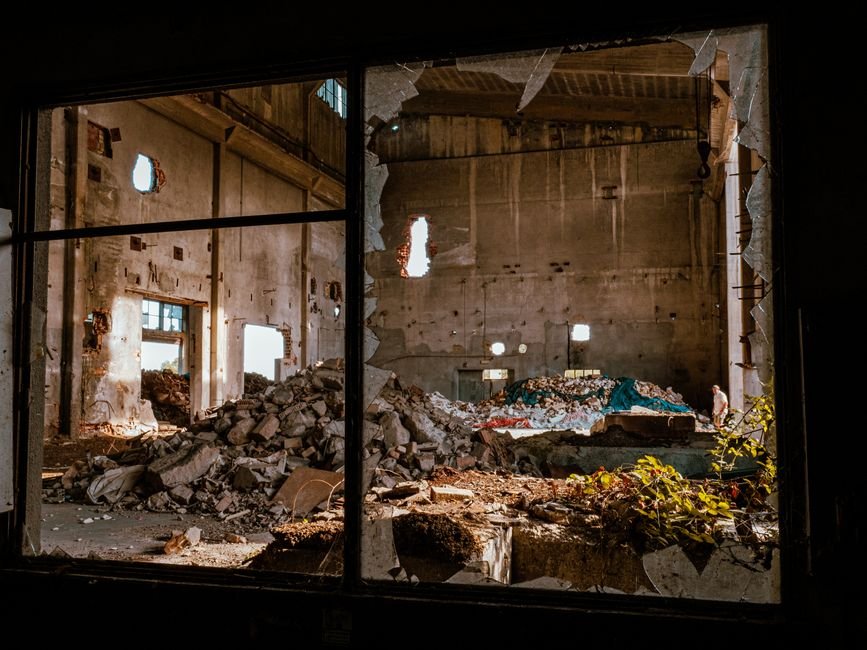
The mine finally closed in 1974, undercut by Japan’s wholesale shift from coal to petroleum, and the entire population was relocated within a matter of months. Doors were left unlocked. Furniture was left in place. Within a couple of decades, the sea air had done what fifty years of subsidence and typhoons could not quite finish, and Gunkanjima became, by most measures, the largest abandoned settlement in the country.
It’s out of that fifty-year silence that the ghost stories grow, and they follow a pattern I’ve come to recognise from other sites I’ve written about: vague, sensory, and almost always secondhand. According to some of the guides and fishermen who work the strait around the island, figures are occasionally seen moving past upper-floor windows in buildings that have had no floors for decades. Others describe a persistent sense of being watched while walking the narrow concrete corridor that tourists are permitted to use, or a cold patch of air near the old hospital block that has no obvious source. I want to be honest that I didn’t experience anything I couldn’t explain by wind funnelling through broken concrete and my own imagination doing what imaginations do in ruins — but I also don’t think the people telling me these stories were making them up to impress a foreign writer. They talked about it the way you’d mention a superstition about a childhood house: half believed, rarely dwelt on, passed along mostly out of habit.
Whether Gunkanjima’s reputation owes more to genuine local folklore or to the island’s more recent life as a filming location and video-game backdrop — it’s widely known as visual inspiration for the villain’s island lair in the 2012 James Bond film Skyfall, and its ruins have shown up in anime and games since — is honestly hard to untangle at this point. Popular culture and local legend have a way of feeding each other on a site like this until nobody can quite remember which came first.
The Rules That Keep It Standing
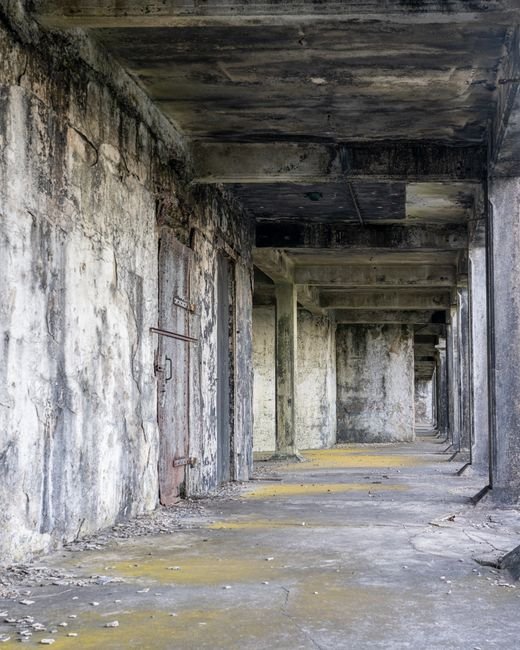
What struck me most, walking the permitted route with a hard hat under one arm, was how carefully managed the whole experience is. Roughly ninety-five percent of the island is closed to visitors entirely because the buildings are structurally unsound; tourists are restricted to a single reinforced walkway near the old administration building, always with a licensed guide, and landings are cancelled outright in anything but calm seas. Unauthorised landing on Hashima is illegal, and for good reason — the concrete is decades past its structural life, and pieces of it come down without much warning. Every operator I dealt with in Nagasaki was upfront about this, and every article I’d recommend reading beforehand says the same thing: this is not a place for a solo, off-the-books explore, however tempting the photographs online might make it look.
If you do want to see it, book with one of the officially licensed tour operators out of Nagasaki port, check the weather the morning of your booking since sailings are cancelled often, and treat the island less like a horror-movie set and more like what it actually is — a real place where thousands of people once lived, worked, and in some cases suffered, within living memory. Whatever you make of the stories the guides tell about shapes in the windows, the more important thing to carry with you off that boat is a bit of respect for the people whose home this used to be.
Note: images accompanying this article are illustrative stock photos and do not necessarily show the specific site discussed.

コメント