






I’ll be honest, I went to Kusatsu expecting a cute little hot spring town, not a destination with a trophy case. But a Japanese friend told me, completely straight-faced, “Kusatsu is basically the undefeated champion,” and she wasn’t exaggerating. Year after year, the travel site Jalan.net runs a nationwide survey asking people to name their favorite onsen resort in Japan, and Kusatsu keeps winning, with Hakone and Dogo trailing behind it. After spending an afternoon there, I get it. This is a town that is completely, unapologetically obsessed with its own hot water, and somehow that obsession is contagious.
Getting there from Tokyo took about three hours total: a limited express train from Ueno Station to Naganohara-Kusatsuguchi, then a 25-minute bus winding up into the mountains. By the time I stepped off, I could already smell the sulfur in the air, faint and a little eggy, and see steam curling up over the rooftops in the distance. That steam, it turns out, is the whole point of the trip.
The Yubatake: Kusatsu’s Steaming Heart
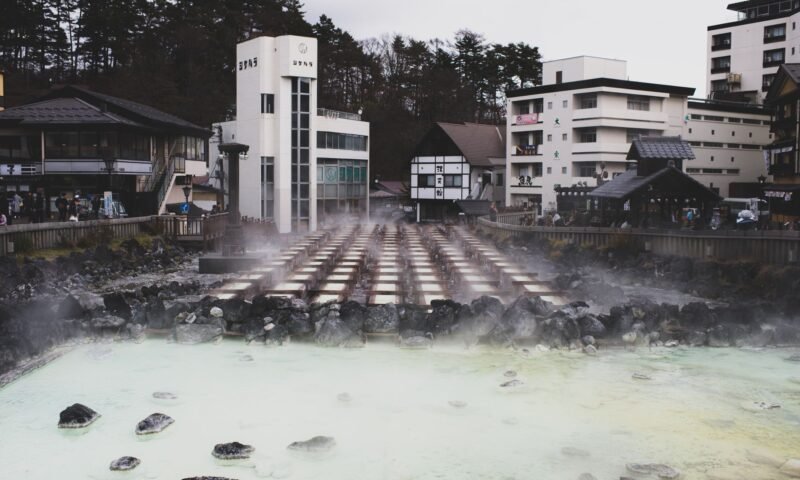
Everything in Kusatsu radiates outward from the Yubatake, or “hot water field,” a wide, sloped field of wooden sluices sitting right in the middle of town. An estimated 5,800 liters of mineral-rich water pour through it every minute, glowing a cloudy yellow-white from the sulfur and dissolved minerals, with steam rising off the whole thing like something out of a hot spring fever dream. Wooden channels fan the water out and cool it slightly as it flows, and workers periodically skim off mineral deposits called yu no hana, literally “hot spring flowers,” which are bottled and sold as souvenir bath salts all over town.
Kusatsu sits on a plateau about 1,200 meters up, and it’s counted among Japan’s “Big Three” hot spring areas, alongside Arima in Hyogo and Gero in Gifu. What makes it stand out, according to that same Jalan survey, is that it has the highest free-flowing water volume of any onsen in the country, plus a notably low pH of around 2.1, which locals will proudly tell you makes it one of the most powerfully antibacterial hot springs anywhere. Back in the Meiji era, a German physician named Erwin Bälz is credited with introducing Kusatsu’s waters to the West, and the town has been quietly flexing about its water quality ever since. There’s also an old local saying that Kusatsu’s springs can cure almost anything, except a broken heart. I can’t vouch for the science on that one, but I appreciated the honesty.
Watching (and Nearly Joining) the Yumomi Show
The water gushing out of the ground in Kusatsu is seriously hot, somewhere between 51 and 94 degrees Celsius depending on the source, which is obviously too hot to just hop into. Diluting it with cold water would be the easy fix, but that waters down the minerals, so locals came up with a different solution centuries ago, apparently dating back to the Edo period: yumomi, or “hot water kneading.” Instead of cooling the water with more water, you stir it, using long wooden paddles to churn the heat out while somehow keeping the chemistry intact.
I watched this turned into a proper performance at Netsu no Yu, a charming two-story wooden hall in a Taisho-era style, just a few minutes’ walk from the Yubatake. Women in traditional dress line up along a long wooden bath, lift paddles that looked to be almost two meters long, and stir the water in unison while singing Kusatsu-bushi, the local folk bathing song, to keep everyone’s rhythm matched. The shows run six times a day, half in the morning and half in the afternoon, each about thirty minutes long, and tickets are sold same-day only at the door. At the end, they invite a few audience members to try the paddle themselves. I volunteered, assuming it would be easy. It was not. Those paddles are heavier than they look, and keeping time with a room full of people singing at you is harder than it sounds.
Sainokawara Park and the Three-Minute Soak
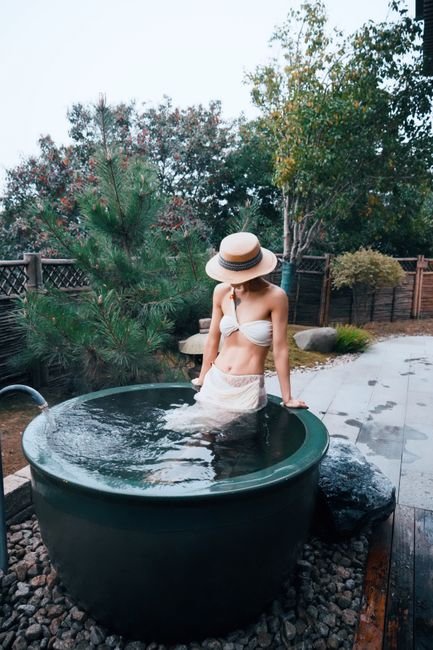
After the show, I wandered down to Sainokawara Park, a riverside stretch a short walk from the center of town where the mountain opens up and the hot spring smell gets stronger. There’s a steaming vent nicknamed Oni-no-chagama, or “the Devil’s Teapot,” bubbling away by the path, and a large open-air bath where you can actually soak in several different types of spring water pooled side by side. Before getting in, I followed the custom I’d just watched performed on stage: stir the water a bit, pour some over your shoulders first to let your body adjust, and only then ease in. Given how acidic and hot this water is, that warm-up isn’t just ceremony, it’s genuinely useful advice.
Traditionally, bathers in Kusatsu don’t linger. The custom, called jikan-yu, is to soak for exactly three minutes, no more, while someone keeps time. It sounds short until you’re actually in water that hot, at which point three minutes feels perfectly reasonable. I came out slightly pink, smelling faintly of sulfur, and oddly calm in a way that lasted the rest of the day.
Practical Tips for Visiting Kusatsu Onsen
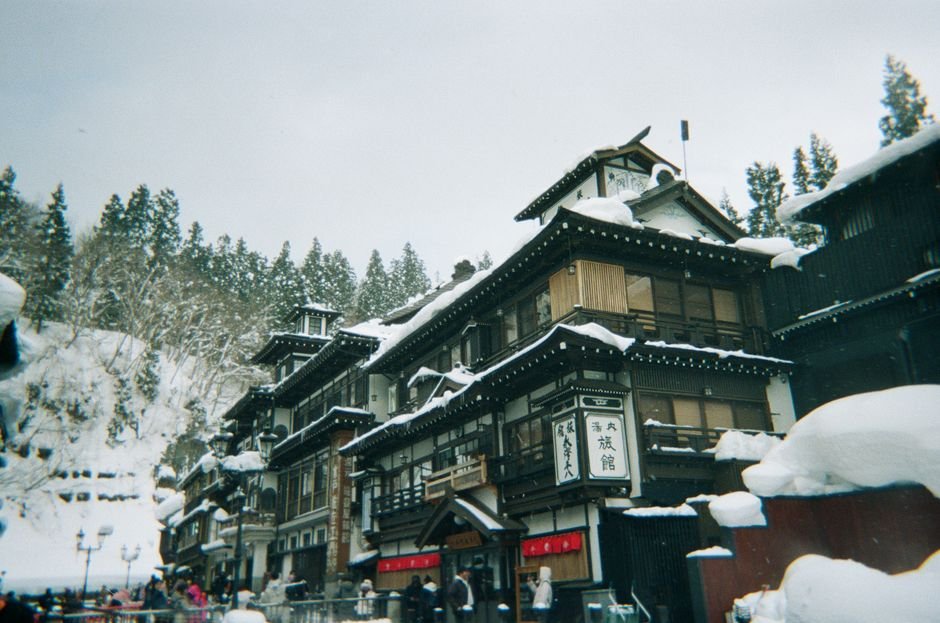
From Tokyo, take a JR limited express from Ueno Station to Naganohara-Kusatsuguchi, which takes roughly two and a half hours, then transfer to a local bus for the last 25 minutes up into the mountains. I’d budget at least half a day for the trip itself if you’re coming from central Tokyo, and ideally stay overnight, since Kusatsu is a classic onsen ryokan town and the Yubatake looks completely different lit up after dark.
Plan your visit around the Netsu no Yu show times if you want to see the yumomi performance, since tickets are same-day only and shows can fill up, especially on weekends. Bring a small towel if you plan on trying any of the public foot baths or communal baths scattered around town, and keep in mind the water is quite acidic, so it’s worth leaving delicate jewelry at the hotel. Cash is still king at a lot of the smaller shops and bathhouses, so don’t count entirely on cards. And whatever you do, don’t rush the Yubatake at midday and move on. Go back after dinner when the crowds thin out and the steam catches the light from the lampposts. That’s when Kusatsu stops feeling like a tourist stop and starts feeling like the kind of place people have been quietly obsessing over for centuries.
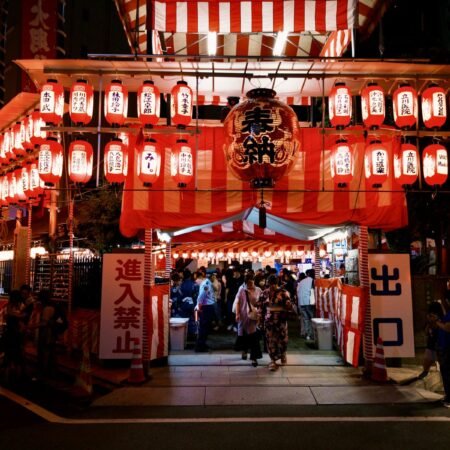
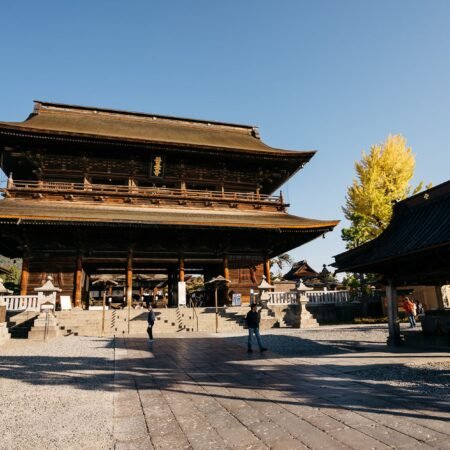
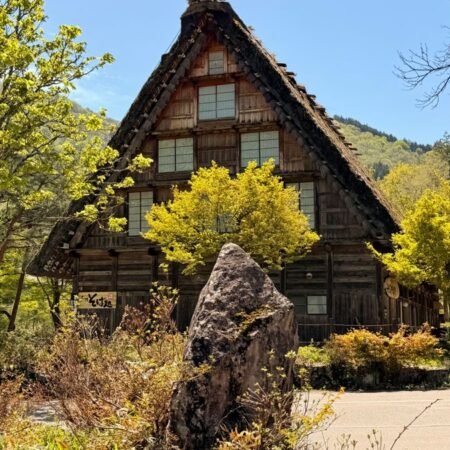
A quick note on photos: some of the images here are stock photos I’ve used to set the mood — they may not be the exact spot or moment I’m describing, just close in spirit.

コメント