




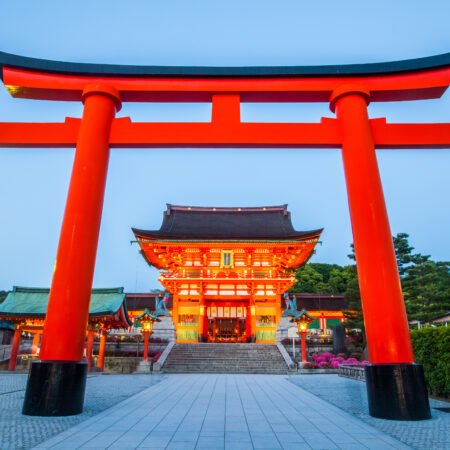

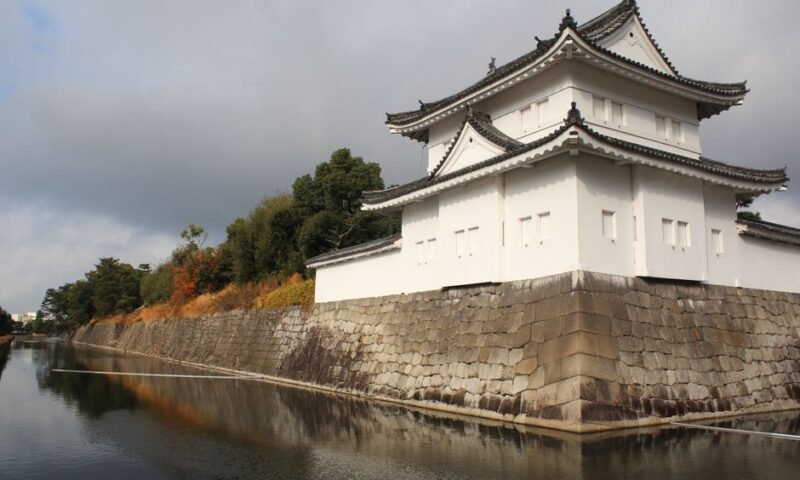
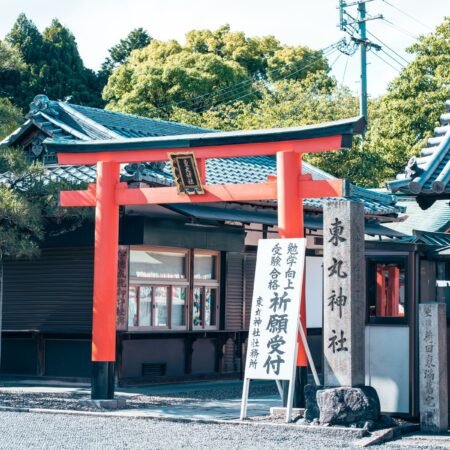
I found the shrine almost by accident. I was walking the perimeter of Nijo Castle’s outer moat on a grey afternoon, more interested in the castle’s stonework than anything else, when a strip of green across the road caught my eye: Nijo Park, an ordinary neighbourhood park with a playground at one end. At the far, quieter end, half-swallowed by shrubbery, stood a small red torii gate I hadn’t read about anywhere. Behind it sat a modest shrine building, and beside that, a landscaped pond no bigger than a suburban garden pool. A sign named the shrine Nue Daimyojin. The pond, it turned out, is called Nue no Ike — the Pond of the Nue.
I had heard the word “nue” before, mostly in the context of Noh theatre, without ever connecting it to a real, walkable patch of ground in Kamigyo Ward. According to the legend, this unglamorous little park is where one of classical Japan’s strangest monster stories reaches its anticlimax — not in a dragon’s lair or a mountain cave, but beside a drainage pond and a children’s slide.
The Night the Emperor Couldn’t Sleep
The story, as it’s recorded in the Heike Monogatari (The Tale of the Heike), is set in the mid-12th century, traditionally dated to 1153. According to the account, the reigning emperor — most versions name Emperor Konoe, though a few later retellings substitute Emperor Nijo, and the written sources don’t fully agree on this point — began falling ill at night. Each evening, the story goes, a strange black cloud drifted over the imperial residence, the Seiryoden, trailing an eerie, bird-like cry. No one could explain it, and the emperor’s health kept deteriorating.
The court eventually called on Minamoto no Yorimasa, a warrior-poet with a reputation for cutting through this kind of trouble. The story goes that Yorimasa took up his bow, waited for the cloud, and fired blind into the dark. Something screamed and fell. His retainer, a man recorded as Ino Hayata (the characters used for his name shift slightly across different sources), rushed in and finished the creature off with a sword.
When they examined the body, so the tale goes, it had the head of a monkey, the torso of a tanuki (the Japanese raccoon dog), the legs of a tiger, and a snake for a tail — a composite animal with no name of its own. Later generations simply began calling it a “nue,” borrowing a word otherwise used for a bird whose nocturnal cry was considered an ill omen. The Heike Monogatari itself, interestingly, never actually names the creature; that identification seems to have come later, through retellings, Noh drama (a play simply titled “Nue” is attributed to Zeami), and Edo-period woodblock prints.
Where Does a Monster’s Body Go?
This is the part of the story I find more interesting than the monster itself: nobody can agree on what happened to the body afterward, and at least three different places in Japan lay some claim to holding it, or to marking where it was buried.
The most commonly repeated version has the corpse placed in a hollowed-out log boat and set adrift down the Kamo River, then the Yodo River, out toward Osaka Bay, eventually washing ashore somewhere between the mouths of the Ashiya and Sumiyoshi rivers in what is now Hyogo Prefecture. Local residents there are said to have buried it out of a mix of fear and respect, and a mound called Nuezuka (“nue mound”) still stands on the bank of the Ashiya River today, near Hanshin Ashiya Station — a modest inscribed stone in a small pine grove, with an explanatory sign put up by the Ashiya City Board of Education. The board itself has said it doesn’t know exactly who originally placed the marker. Notably, in October 2021, around thirty people, including Shinto priests from Ashiya Shrine, gathered there for a memorial service connected to the COVID-19 pandemic, with an excerpt from the Noh play “Nue” performed as part of the ceremony. Whatever one makes of the original legend, the ritual built around it is clearly still a living one.
A second claimed Nuezuka sits in Miyakojima Ward, Osaka, where a small shrine and mound were restored in 1870 and again by local residents in 1957; the Port of Osaka even adopted a nue motif as part of its official emblem in 1980. A third mound, near Okazaki Park in Kyoto, is also sometimes called Nuezuka, though by most accounts I could find, its actual connection to this particular story is unclear at best. Older texts complicate things further still: the Genpei Seisuiki and the Edo-period Kandenjihitsu both place the burial at Kiyomizu-dera instead, and claim that digging up the remains during the Edo period brought a curse down on whoever disturbed them.
A Pond, a Shrine, and Some Stones Nobody Touches
Which brings us back to the small park by Nijo Castle. The pond and shrine there aren’t about the body at all — according to local tradition, they mark the spot where Yorimasa washed the blood off his arrow after the kill (I also came across a variant telling locally in which the nue first fell out of a tree rather than a cloud). A cluster of large stones near the shrine are known as nue-ishi, and local tradition holds that touching them invites bad luck. I didn’t test this personally; I’m fond of my luck as it currently stands.
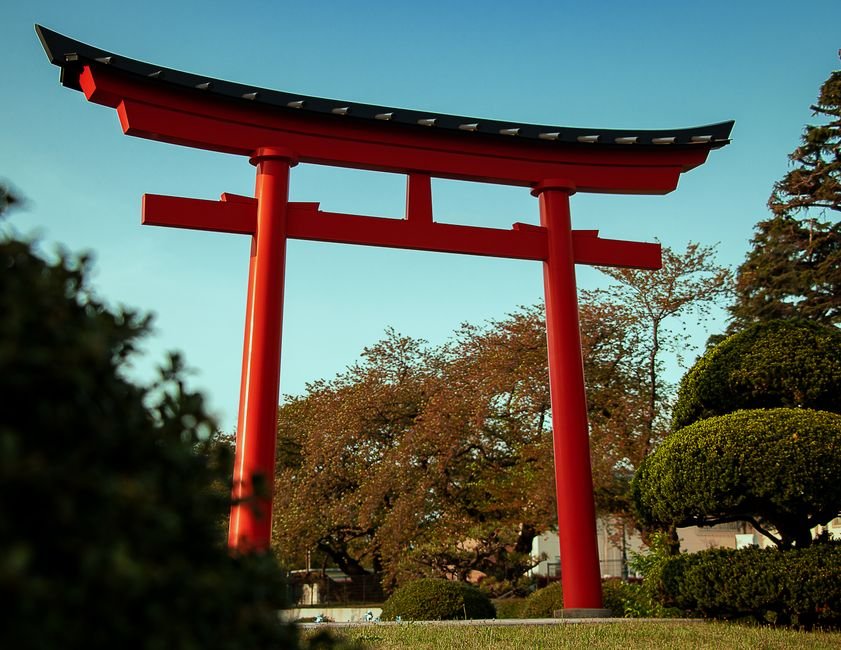
The shrine’s current form appears to date to the 1930s, when the surrounding area was developed into a public park, and the pond itself has clearly been reshaped and landscaped since the Heian period — what’s there today is best understood as a marker of memory rather than an archaeological survival. That doesn’t make it any less worth a visit. There is something quietly fitting about a near-900-year-old monster story being folded into an ordinary city park with a sandbox twenty metres away, as though Kyoto simply absorbed the thing into daily life rather than fencing it off as a curiosity.
Visiting Respectfully
If you want to see this for yourself, Nijo Park is a short walk from Nijojo-mae Station on the Tozai Line, across the road from Nijo Castle’s northern moat — it’s an open, free public park with no special hours or admission. The Ashiya mound is similarly accessible, a short walk from Hanshin Ashiya Station along the Ashiya River. Neither site asks anything of a visitor beyond the manners you’d use at any small shrine or memorial marker: keep your voice down near the shrine building, don’t climb on or move the stones, and if you come across an offering or a tended marker, leave it exactly as you found it. These remain, in a small way, places of local memory and ongoing practice, not film sets. And for what it’s worth, I’d gently suggest not test-driving the nue-ishi curse on my account — some traditions are worth honouring out of simple courtesy, whether or not you believe a word of the underlying story.
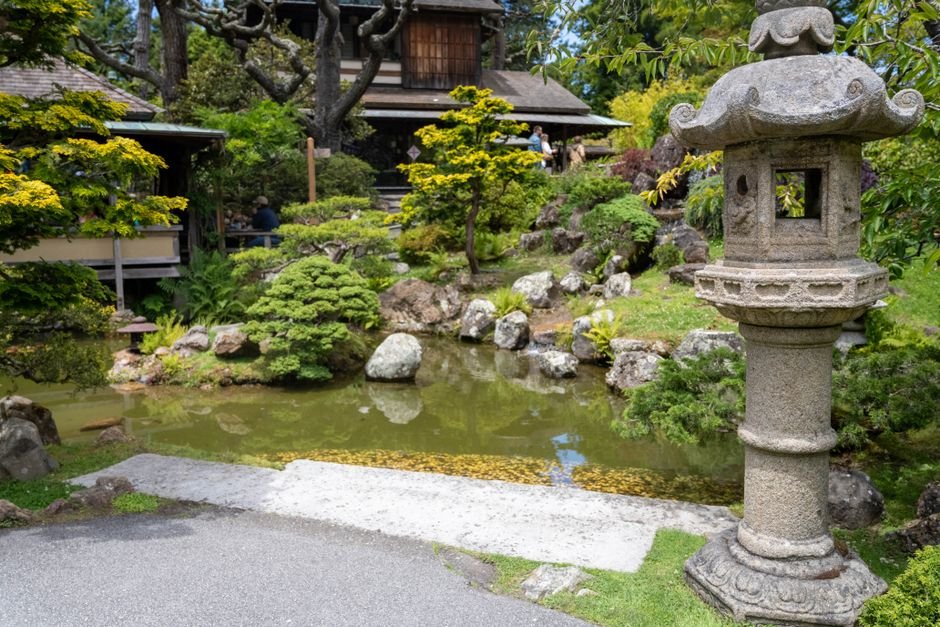
Note: images accompanying this article are illustrative stock photos and do not necessarily show the specific site discussed.

コメント