





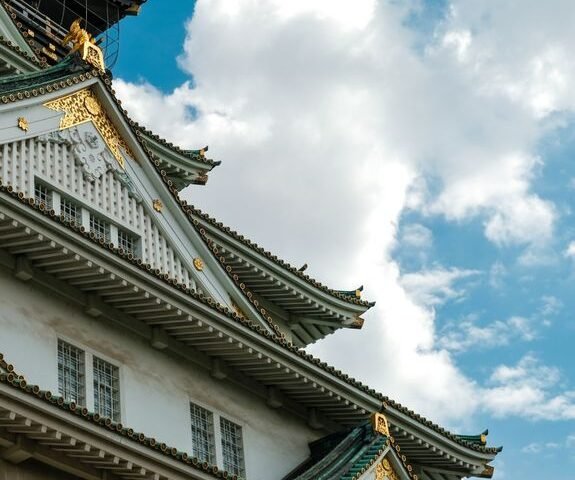
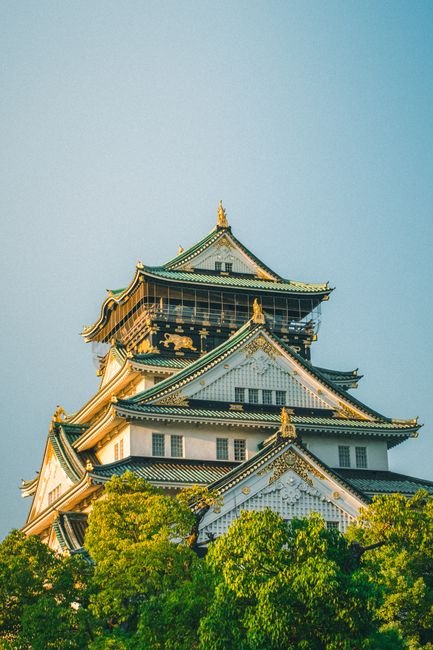
There is a stone marker in a quiet corner of Osaka Castle Park that most visitors walk straight past. It sits in an enclosure called Yamazato-maru, behind the great white keep that every tour bus in Kansai stops to photograph, and it is easy to miss if you are looking up at the gold-trimmed roof tiles instead of down at the ground. I found it on a grey afternoon in early winter, after the crowds around the keep had thinned, and I stood there longer than I meant to. The inscription says this is, roughly, the place where a prince and his mother died on the last day of their family’s rule. I say “roughly” because, as I spent the following weeks discovering, almost nothing about that final day is as settled as the stone makes it sound — including, according to one persistent and carefully documented legend, whether the prince died there at all.
The Day the Toyotomi Line Ended
Osaka Castle was built from 1583 by Toyotomi Hideyoshi, the farmer’s son who unified Japan, and for a few decades it was the largest, richest fortress in the country. After Hideyoshi’s death, his young son Hideyori inherited the castle, and with it a target on his back. Tokugawa Ieyasu, the rival who had out-waited Hideyoshi’s old allies, spent years tightening the noose. A dispute over the wording cast into a temple bell in 1614 gave him the pretext for the Winter Campaign; a shaky peace followed; and in the summer of 1615 his army came back to finish the job.
By 7 May, Tokugawa forces had broken the Toyotomi lines at Tennoji, and the castle itself was burning. According to the Sunpu-ki, a diary kept by officials close to Ieyasu, the order came at noon the next day, 8 May 1615, for Hideyori, his mother Yodo-dono, and those sheltering with them in the castle’s inner enclosures to take their own lives. Contemporary letters, including one from the daimyo Date Masamune, describe Hideyori’s final hours less as a battle than a siege of a burning storehouse, where he had barricaded himself with a handful of retainers. One tradition holds that the general Ōno Harunaga offered to trade Hideyori’s wife, Senhime — who happened to be Ieyasu’s own granddaughter — for Hideyori’s life, and that Ieyasu refused. Yodo-dono, the story goes, turned down a chance to save herself rather than abandon the retainers dying beside her. By that afternoon the dynasty was finished, and the bodies pulled from the ashes were reportedly too burned to identify with any confidence.
A Skull, a Monument, and an Argument About Where It Happened
The stone I found marking the “place of self-immolation” was only put up in 1997, a fact the city’s own tourism literature is honest about. A separate, older memorial tower nearby — dedicated to Yodo-dono and the thirty-two retainers said to have died with her — stands on the opposite side of the same enclosure, which tells you something useful: nobody is entirely certain which patch of ground to point at. The Sunpu-ki itself names a different area, the Obi-kuruwa, as the enclosure the shogunate’s order targeted, and more than one historian has noted that four centuries, several fires, and a near-total rebuilding of the castle by the Tokugawa in the 1620s have made it almost impossible to say “here, exactly” with a straight face.
That hasn’t stopped people from trying. In 1980, excavation work in the old Sannomaru district turned up a skull bearing what looked like sword cuts, buried several metres down alongside two headless skeletons and a horse’s skull. It made the news, and has been linked, speculatively and inconsistently across accounts, to the castle’s fall. More sober local historians point to the find’s depth and location relative to where the keep actually stood, and note that no detail lines up cleanly with any single named victim. It is the kind of find that is genuinely evocative and genuinely inconclusive, and that combination, more than any apparition, is what gives this corner of the park its atmosphere. You are standing somewhere that holds violent death in its soil. You just cannot say whose.
The Ghost Tours, and a Legend That Refuses to Stay Buried
Osaka Castle has, in recent years, become a stop on a small industry of English-language “haunted history” night walks, sold to tourists alongside Namba’s neon. I went on one. The guide was good company and knew her Sengoku-period history cold, but when it came to specific ghost sightings — a cold spot by the keep, a shape on the battlements — the stories were vague, undated, and untraceable to anything older than the tour company’s own marketing copy. I don’t say that to be dismissive; I think the castle’s genuine ghost story is a stranger, better-documented one than “cold spot by the keep,” and it isn’t really about a ghost at all.
According to a theory laid out most thoroughly in a 1997 book by the historian Kazuhiko Maekawa, Hideyori did not die in that burning storehouse. It holds that he escaped through a tunnel near the Kyōbashi gate with help from retainers loyal to the distant Satsuma domain, sailed down the Yodo River, and was carried by Satsuma ships to Kyushu, where he lived out his life under an assumed name, “Sōren,” in villages around what is now Kagoshima. Local tradition in the Tanyama and Fukumoto areas, along with a surviving Kinoshita family genealogy from the Hiji domain recording an unnamed “sixth son,” is offered as supporting evidence. In Kagoshima, a yearly observance called the Myōenji mairi is still connected, in local memory, to the idea that even Hideyori’s infant son Kunimatsu — recorded elsewhere as captured and beheaded as a child — secretly survived and was raised there too. Mainstream historians treat this as an unverified, if carefully kept, local tradition rather than fact, and even the source that lays it out most fully says plainly that what can be confirmed is that the story was handed down, not that it is true. But as someone who spends his weekends chasing this country’s quieter ghost stories, I find something fitting in it: the “haunted” ground at Yamazato-maru may, by its own legend elsewhere in Japan, be haunted by someone who was never actually there to die.
Visiting Respectfully
Osaka Castle Park is one of the most heavily visited sites in Japan, and Yamazato-maru sits within the normal, freely accessible walking route behind the keep — there is no need, and no legal way, to go looking for anything beyond the marked paths, since the excavated areas were filled in long ago. If you go, as I did, in the quieter hours near closing, treat the memorial stones the way you would any other grave marker: don’t climb on them, don’t leave anything behind that isn’t a proper offering, and keep your voice down if other visitors are standing in quiet reflection rather than taking photographs. Whatever you make of the ghost tours or the Satsuma legend, this remains a place where real people, whoever exactly they were, died violently for ambitions that outlived them. That seems worth a moment of plain respect, with or without a ghost attached to it.
Note: images accompanying this article are illustrative stock photos and do not necessarily show the specific site discussed.

コメント