





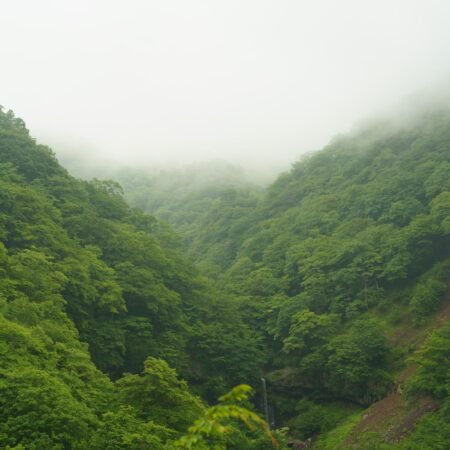
The bus from Hagi’s city centre thins out of passengers long before it reaches Kibe. By the last stop it was just me and the driver, and then a thirty-minute walk along a single-lane road with rice terraces on one side and forested hills on the other. I’d come to Yamaguchi Prefecture for castle ruins and samurai streets, the kind of place every guidebook photographs at golden hour. I had not expected to end the day sitting in front of a small Zen temple covered, almost floor to ceiling, in cats.
Unrinji, Hagi’s quiet cat temple, is easy to miss if you don’t know to look for it. It sits at the end of a quiet mountain road in Kibe, a hamlet inside Hagi city limits, and for most of its four-hundred-odd-year history it was simply a modest sub-temple of Tenjuin, the larger temple that enshrines the Mōri clan. These days it has a nickname that gets it mentioned in places Tenjuin never is: Neko-dera, the Cat Temple. The reason has nothing to do with marketing and everything to do with a story local people have been telling, in one form or another, since the early Edo period — a story about loyalty, grief, and a sound that supposedly would not stop until someone finally listened.
The Lord Who Moved His Capital to Hagi
To understand why a temple in the hills ended up tangled in a ghost story, you have to start with the man at Tenjuin: Mōri Terumoto. Terumoto was one of the great daimyo of western Japan, grandson of the legendary strategist Mōri Motonari, and on the losing side of the 1600 Battle of Sekigahara that decided who would run the country for the next two and a half centuries. The Tokugawa victors stripped the Mōri of most of their territory and pushed them out of their old castle town. Around 1604, Terumoto resettled what remained of his domain in Hagi, a coastal backwater at the time, and built a new castle there. It became the seat of the Chōshū domain for the rest of the Edo period. Terumoto died in 1625 and was enshrined at Tenjuin, which still stands near the old castle grounds today.
It’s the kind of history that doesn’t need embellishing — a powerful clan knocked down several rungs, forced to start over in an unglamorous corner of the country. But according to local tradition, Terumoto’s death set off something smaller and stranger than politics.
A Retainer’s Final Duty, and the Cat Who Would Not Leave
The story, as it’s told around Hagi, says that one of Terumoto’s retainers, a man named Nagai Motofusa, followed his lord in death — an act known in the period as junshi, in which a vassal takes his own life to accompany his master into the next world. It was an old, formalised expression of loyalty, not an impulsive act, and one the Tokugawa shogunate would eventually ban outright decades later precisely because it kept happening. In 1625, though, the ban was still in the future, and Motofusa’s death was recorded as exactly that kind of final duty.
What local tradition adds is the detail that makes this a cat story rather than just a samurai one: Motofusa, it’s said, kept a cat, and the animal is supposed to have grieved so deeply after his death that it bit through its own tongue and died alongside him. According to the legend — and I want to be clear this is denshō, a handed-down tale rather than a verified event — a lonesome, crying sound began to be heard around the temple grounds at night not long afterward. It apparently went on long enough, and unsettled enough people, that a monk eventually held a memorial service specifically for the cat’s spirit. After that, the story goes, the crying stopped.
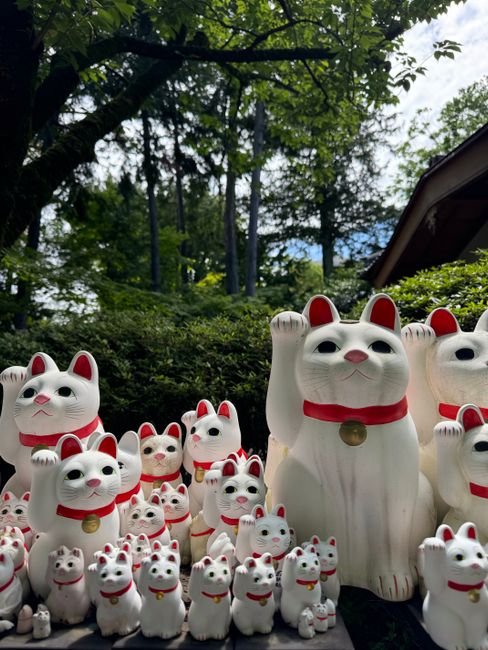
It’s worth saying plainly that the documented link between this tale and Unrinji itself is thin — Japan’s own tourism authority, which maintains a public record on the temple, describes the connection as tenuous rather than established. What survives clearly in the historical record is Motofusa’s death and the custom of junshi itself; the cat is folklore stitched onto it, the kind of story that gives an otherwise private, formal act of feudal loyalty a shape ordinary people could hold onto and retell.
From a Quiet Memorial to a Temple Full of Cats
For most of its existence, Unrinji carried this story quietly, the way small countryside temples carry most of their history — known to locals, absent from guidebooks. That changed under its current head monk, Sumida Jisei, who has led the temple since 1996 and leaned into the Neko-dera identity rather than letting it fade. Walk the grounds today and you’ll find donated cat paintings and drawings covering interior walls, wooden cat sculptures carved by a local chainsaw artist, cat-shaped ema votive plaques, and cat-themed charms sold alongside the temple’s more conventional offerings. The head monk is known for holding memorial services for pets generally, not just the legendary cat from four centuries ago, which gives the place a gentler, more contemporary purpose than its origin story might suggest.
There’s also a second, separate collection worth knowing about before you go: more than eight hundred Jizō statues, the small stone guardians associated with protecting children and travellers, relocated to the temple grounds from a nearby village. Between the Jizō and the cat art, Unrinji ends up feeling less like a haunted site in the jump-scare sense and more like a place that has quietly decided to hold onto things other locations let go of — a vassal’s loyalty, a village’s roadside shrines, a story about grief that refused to stay buried.
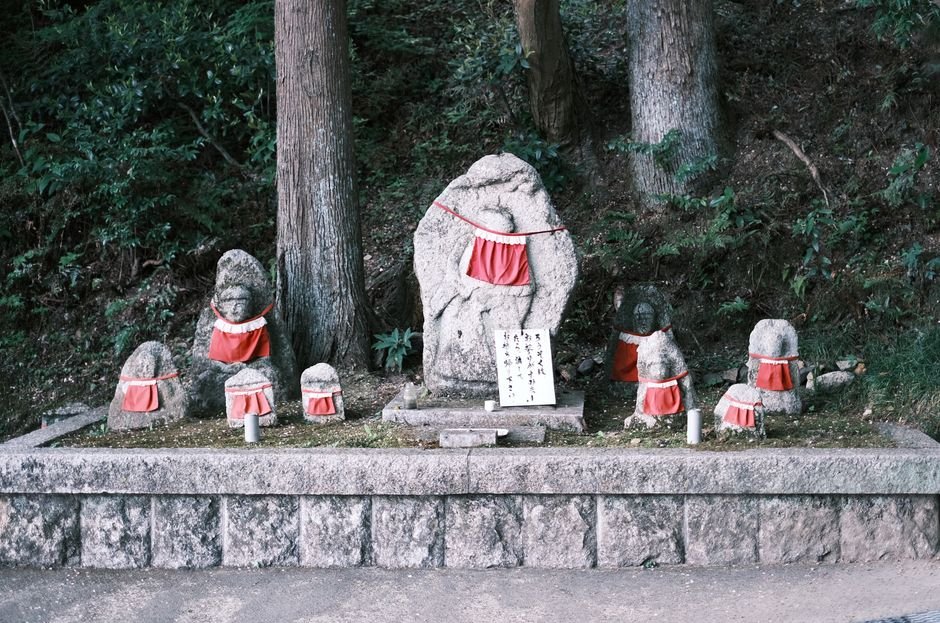
I didn’t feel unsettled sitting there in the late afternoon. If anything, it was one of the more peaceful hours I’ve spent researching these stories — which is, I think, rather the point. Unrinji isn’t selling a scare. It’s keeping a four-hundred-year-old act of devotion, human and feline both, from being forgotten entirely.
If you’re planning a visit, Unrinji is a working temple, not a tourist attraction built for crowds, so the usual rules of courtesy apply and then some. Admission is free, though donations are appreciated given how much the temple’s upkeep relies on them. It keeps modest hours — roughly 9:00 to 15:00 on weekdays and 9:00 to 17:00 on weekends and holidays — so it’s worth checking ahead, especially if you’re relying on the infrequent Bōchō bus service from Hagi’s city centre rather than a car. Treat the donated artwork, the ema, and the Jizō statues with the same respect you’d show at any temple: look without touching, keep your voice down, and remember that this is still an active place of worship and memorial, not a themed stop on a ghost tour. If you happen to visit around dusk, when the hills around Kibe go quiet, it’s easy to understand how a story like this one took root here in the first place.
Note: images accompanying this article are illustrative stock photos and do not necessarily show the specific site discussed.
コメント